From Abracadabra to Zombies | View All
Maya prophecy (2012)
Tzuhtz-(a)h-oom u(y)-uxlahuun pik (ta) Chan Ahaw, ux(-te') Uniiw. Uht-oom ? Y-em(al) (?) Bolon Yookte' K'uh ta (?). ("The thirteenth pik will be finished (on) Four Ahaw, the third of K'ank'in. ? will occur. (?) the Nine Foot Tree God(s) to (?).")*
The world will not end on 12-21-2012, at least not according to the Maya, who knew about as much about our planet's future demise as Gordon-Michael Scallion, St. Malachy, Edgar Cayce, Zecharia Sitchin, or Nostradamus, namely, nothing. The Maya had zero, zilch, nada, mix bá'al to say about the hoax planet Nibiru or the end of the world.
Maya urban culture, known as the Classic Period, flourished from about 250 CE until around 900 CE in Mexico's Yucatán Peninsula and parts of Central America. During this period the Maya built temples and monuments, created numerous works of art and writings, continued their astronomical observations, and built a network of cities. These cities lay buried under jungle growth for centuries. Excavation in Guatemala indicates Maya culture was quite advanced as early as 200 to 150 BCE.
One of the important discoveries from the Yucatan ruins is that the Maya had several calendars. One is known as the Long Count calendar, which is reset to day 0 every 1,872,000 days, a period known as The Great Circle (Diamond 2005: 167). The next reset date, by some calculations, is December 21, 2012. Obviously, this calendar is of no interest to the Maya any longer, since their civilization collapsed over a thousand years ago. (Though there are people today who are the descendants of the Maya and the culture lives on through them.*) Nevertheless, this date is of enormous interest to certain doomsday prophets and New Age astrologers, such as John Calleman, who are spreading the good news either that the Maya knew the date when the world would end or they knew the date when a New Age of Transformation would begin.* (The Mayan glyphs and hieroglyphs aren't crystal clear about what the calendar means.) Too bad they couldn't predict their own collapse.
According to Jared Diamond,
The famous Maya Long Count calendar begins on August 11, 3114 B.C.--just as our own calendar begins on January 1 of the first year of the Christian era....Presumably, the Maya...attached some significance to their own day zero, but we don't know what it was. (Diamond 2005: 167)
There was no writing in the New World until 2,500 years after the Maya year zero but there is evidence of agriculture in Mesoamerica from about the time of day zero on the Maya calendar. This could be just a coincidence, since the areas where agriculture first emerged were not the areas where the Maya would eventually build their cities.
The Maya Long Count calendar is based on a complex system of units ranging from days (kin) to 144,000 days (baktun).
Whatever virtues the Classic Maya culture might have had, predicting the future seems an unlikely one. This fact has not stopped some very bizarre speculation about Maya astronomy. The speculators should ask themselves: what is the likelihood that a civilization that couldn't use its vast knowledge to save itself from self-destruction was concerned with predicting what would happen in a future millennium? The Maya leaders couldn't see far enough into the future to plan for and solve the human problems they faced: too many people on too little land, destruction of their own environment, farming techniques and deforestation that depleted soil nutrients, droughts (partly brought on by their deforestation programs), and so on. Why should we think the Maya prophets would be any better at seeing the distant future than the Hebrew prophets or Nostradamus?
the "Cosmic" Maya
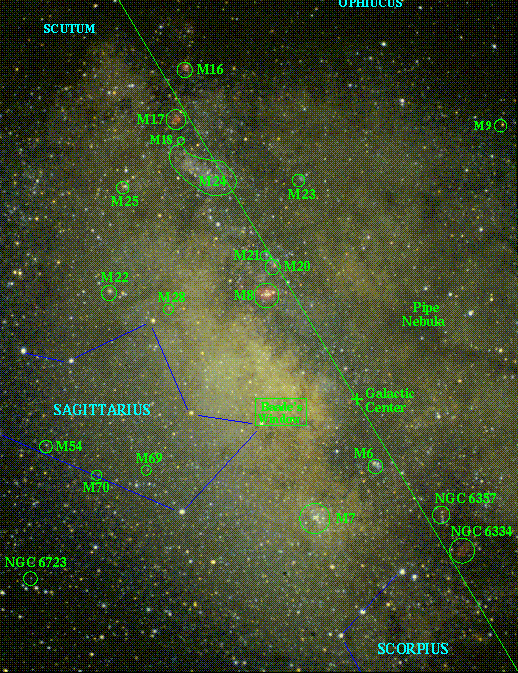
Dee Finney's Maya prophecy website promotes the idea of the "Cosmic" Maya. Finney's source for much of the prophecy speculation is Charles Gallenkamp's book Maya: The Riddle and Rediscovery of a Lost Civilization. On December 21, 2012, there will be an "alignment between the galactic and solar planes." The winter solstice sun will "conjunct the Milky Way." This is supposed to open up some sort of "cosmic sky portal." You can see a picture of this alignment here. But the picture can only be properly explained by an astrologer, such as John Major Jenkins:
If we make a standard horoscope chart for December 21st, 2012 A.D., nothing very unusual appears. In this way I was led astray in my search until Linda Schele provided a clue in the recent book Maya Cosmos. Probably the most exciting breakthrough in this book is her identification of the astronomical meaning of the Mayan Sacred Tree. Drawing from an impressive amount of iconographic evidence, and generously sharing the process by which she arrived at her discovery, the Sacred Tree is found to be none other than the crossing point of the ecliptic with the band of the Milky Way. Indeed, the Milky Way seems to have played an important role in Mayan imagery. For example, an incised bone from 8th century Tikal depicts a long sinking canoe containing various deities. This is a picture of the night sky and the canoe is the Milky Way, sinking below the horizon as the night progresses, and carrying with it deities representing the nearby constellations.
The incredible Mayan site of Palenque is filled with Sacred Tree motifs and references to astronomical events. In their book [A] Forest of Kings, Schele and Freidel suggested that the Sacred Tree referred to the ecliptic. Apparently that was only part of the picture, for the Sacred Tree that [the Mayan king] Pacal ascends in death is more than just the ecliptic, it is the sacred doorway to the underworld. The crossing point of Milky Way and ecliptic is this doorway and represents the sacred source and origin. [Apparently, Jenkins is interpreting Pacal's sarcophagus, which depicts the Sacred Tree emerging from what has been called an umbilical cord.*]
While it is true that the sun conjuncts the Sacred Tree on December 3rd in the year 755 A.D., over the centuries precession has caused the conjunction date to approach the winter solstice. So, how close are we to perfect conjunction today? Exactly when might we expect the winter solstice sun to conjunct the crossing point of Galactic Equator and ecliptic - the Mayan Sacred Tree? Any astronomer will tell you that, presently, the Milky Way crosses the ecliptic through the constellation of Sagittarius and this area is rich in nebulae and high density objects. In fact, where the Milky Way crosses the ecliptic in Sagittarius also happens to be the direction of the Galactic Center.
Any astronomer will probably also tell you that an alignment between our sun and any particular point in the Milky Way will just bring another day in paradise here on planet Earth. In any case, Jenkins is not alone in his interpretation of the mysterious Maya Long Count calendar.
A Guatemalan anthropologist and student of Maya history and calendars, Carlos Barrios, has a similar interpretation. It is true that the Long Count calendar ends in December of 2012, but the world will not. According to Mr. Barrios, the end of the calendar signals a transformation of some sort, but not the end of the world. Barrios does not deny that the Maya were prophets, however. According to him, their calendars predicted the coming of Cortez in 1519.
The Mayan Calendars comprehension of time, seasons, and cycles has proven itself to be vast and sophisticated. The Maya understand 17 different calendars, some of them charting time accurately over a span of more than ten million years. The calendar that has steadily drawn global attention since 1987 is called the Tzolk'in or Cholq'ij. Devised ages ago and based on the cycle of the Pleiades, it is still held as sacred. With the indigenous calendars, native people have kept track of important turning points in history. For example, the daykeepers who study the calendars identified an important day in the year One Reed, Ce Acatal, as it was called by the Mexicans. That was the day when an important ancestor was prophesied to return, "coming like a butterfly." In the western calendar, the One Reed date correlates to Easter Sunday, April 21, 1519 the day that Hernando Cortez and his fleet of 11 Spanish galleons arrived from the East at what is today called Vera Cruz, Mexico.
When the Spanish ships came toward shore, native people were waiting and watching to see how it would go. The billowing sails of the ships did indeed remind the scouts of butterflies skimming the ocean surface.
How Barrios knows what the scouts were thinking is anybody's guess. (When I try to imagine myself in the place of the scouts seeing a fleet of ships sailing towards the shore I don't see skimming butterflies; I see trouble. Why is my hindsight different than that of Barrios? Are we shoehorning data to fit our beliefs?)
What will this "transformation" be like when we reach the end of one of these 17 calendars?
It will be the start of a new era resulting from and signified by the solar meridian crossing the galactic equator, and the earth aligning itself with the center of the galaxy.
At sunrise on December 21, 2012 for the first time in 26,000 years the Sun rises to conjunct the intersection of the Milky Way and the plane of the ecliptic. This cosmic cross is considered to be an embodiment of the Sacred Tree, The Tree of Life, a tree remembered in all the world's spiritual traditions. Some observers say this alignment with the heart of the galaxy in 2012 will open a channel for cosmic energy to flow through the earth, cleansing it and all that dwells upon it, raising all to a higher level of vibration.
That sounds swell and we should all look forward to having our vibration level increased. However, the mundane facts indicate that the Maya kings and nobles focused more on short-term projects like enriching themselves and building monuments (Diamond 2005: 177) than in predicting the dawning of the Age of High Vibration long after their civilization had collapsed.
See also doomsday & doomsday cults.
further reading
books and articles
Coe, Michael. (1999). The Maya. 6th edition. Thames & Hudson.
Coe, Michael. (1999). Breaking the Maya Code. Revised edition. Thames & Hudson.
Diamond, Jared. (2005). Collapse: How Societies Choose to Fail or Succeed. Viking.
Sitler, Robert K. 2006. The 2012 Phenomenon New Age Appropriation of an Ancient Mayan Calendar. Nova Religio. February, Vol. 9, No. 3, Pages 24–38.
What You Should Know About 2012: Answers to 13 Questions 3. Does the Maya calendar end on December 21, 2012? No.
A Brief History of the Apocalypse "The 21st century has begun in earnest! And despite the cries of doomsayers, psychics, and prophets, the world has not come to an end! Is the idea that the end is near a recent phenomenon? Far from it. Indeed, Chicken Littles have crying doom since ancient times. The aim of this page is to debunk end-time prophecy by listing hundreds of failed doomsday predictions, allay the fears spread by end-time preachers, and demonstrate that doomcrying is nothing new."
2012: Are We All Going to Die? (Liam McDaid's astronomy-oriented and skeptical page)
15 END-OF-THE-WORLD PROPHECIES in 2006
THE HOW AND WHY OF THE MAYAN END DATE IN 2012 A.D. by John Major Jenkins
The Maya finally speak up about the meaning of 2012 "The Maya have taken center stage because many fear the supposed end date of their calendar marks the end of the world. Most of this information comes from non-Mayans and it is not accurate...." --Wandering Wolf
French village wants army to bar New Age fanatics: Esoteric outsiders believe only Bugarach will be spared Armageddon in 2012 "This is no laughing matter," said Jean-Pierre Delord, the mayor. "If tomorrow 10,000 people turn up, as a village of 200 people we will not be able to cope. I have informed the regional authorities of our concerns and want the army to be at hand if necessary come December 2012."
End of the Earth Postponed by Stephanie Pappas, LiveScience "...accepted conversions of dates from Mayan to the modern calendar may be off by as much as 50 or 100 years."
Giant spaceships to attack December 2012? ...an article on The Examiner’s website documents three spaceships, shows images, and even has quotes from a SETI astrophysicist!....There are some teeny, tiny, problems with this story, though. Like, the "spaceships" are actually image defects and aren’t real, there’s no way to figure out how big they from the picture, and the "astrophysicist" quoted in the article doesn’t even exist.


 maternal
impressions
maternal
impressions