

From Abracadabra to Zombies | View All
UFO (unidentified flying object)
"…nothing has come from the study of UFOs in the past 21 years that has added to scientific knowledge...further extensive study of UFOs probably cannot be justified in the expectation that science will be advanced thereby." –Edward U. Condon"Choose the nearest star; decide how long you're willing to travel, how fast you will need to go to get there in that time, what you will have to take with you, and how many should be in the crew. Make it a one-way suicide mission if you wish. As a final step, calculate the kinetic energy that must be imparted to the spaceship to get you there in that time (one half the mass times the velocity squared.) I suggest you stay away from the relativistic limit; it complicates the calculation and won't help you anyway. The good news is that you will then sleep secure in the knowledge that UFOs from elsewhere in the galaxy are not subjecting humans to hideous experiments." --Bob Park
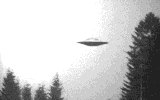 A UFO is an unidentified flying object
that has been
identified as a possible or actual alien spacecraft. Such objects include meteors,
disintegrating satellites, flocks of birds, aircraft, lights, weather balloons, and just
about anything moving within the visible band of electromagnetism. So far, however, nothing has
been positively identified as an alien spacecraft in a way required by common sense and
science. That is, there has been no recurring identical UFO experience and there is no
physical evidence in support of either a UFO flyby or landing.
A UFO is an unidentified flying object
that has been
identified as a possible or actual alien spacecraft. Such objects include meteors,
disintegrating satellites, flocks of birds, aircraft, lights, weather balloons, and just
about anything moving within the visible band of electromagnetism. So far, however, nothing has
been positively identified as an alien spacecraft in a way required by common sense and
science. That is, there has been no recurring identical UFO experience and there is no
physical evidence in support of either a UFO flyby or landing.
There are as many photographs of UFOs as there are of the Loch Ness Monster, and they are of equal quality: blurs and forgeries. Oddly, the advent of inexpensive video cameras has corresponded to a decrease in UFO sightings.* Other physical evidence, such as alleged debris from alien crashes, or burn marks on the ground from alien landings, or implants in noses or brains of alien abductees, have turned out to be quite terrestrial, including forgeries. The main reasons for believing in UFOs are the questionable interpretations of visual experiences, the testimony of many people, the inability to distinguish science fiction from science, the willingness to trust incompetent men telling fantastic stories, the ability to distrust all contrary sources as being part of an evil conspiracy to withhold the truth, and a desire for contact with the world above. Belief in aliens and UFOs is akin to belief in supernatural beings. As Paul Kurtz says:
UFOlogy is the mythology of the space age. Rather than angels ... we now have ... extraterrestrials. It is the product of the creative imagination. It serves a poetic and existential function. It seeks to give man deeper roots and bearings in the universe. It is an expression of our hunger for mystery...our hope for transcendental meaning. The gods of Mt. Olympus have been transformed into space voyagers, transporting us by our dreams to other realms.
Dr. J. Allen Hynek, astronomer, foremost proponent of UFOs, and the one who came up with the expression "close encounters of the third kind," defines a UFO as:
[T]he reported perception of an object or light seen in the sky or upon land the appearance, trajectory, and general dynamic and luminescent behavior of which do not suggest a logical, conventional explanation and which is not only mystifying to the original percipients but remains unidentified after close scrutiny of all available evidence by persons who are technically capable of making a common sense identification, if one is possible.
These mystifying words seem to say that when you see something which intelligent people cannot rationally explain, then you are seeing a UFO. Witnesses to such sightings often claim that what they saw could not be explained by the known laws of physics. They claim to have witnessed a violation of a law of nature, i.e., a miracle. Dan Aykroyd, for example, claims he saw "high altitude, glowing magnesium discs traveling at 20,000 miles (32,190 km) an hour at 100,000 feet (30,480 meters). ... wing to wing, edge to edge."* How he determined the composition of the "discs" or calculated their speeds and distances is anyone's guess.
What Hynek considers to be "all available evidence" may be much less than what a skeptic would require. For example, the evidence appealed to by UFOlogists consists of (1) the testimony of people who claim to have seen aliens and/or alien spacecraft; (2) facts about the type of people who give the testimony; (3) the lack of contrary testimony or physical evidence that would either explain the sighting by conventional means (weather balloon, prank, meteor shower, reflection of light, etc.) or discredit the reliability of the eyewitness; and, (4) alleged weaknesses in the arguments of skeptics against the UFOlogists. The last item is irrelevant to the issue, yet it plays a disproportionately large role in UFOlogy.
Attacking an opponent's arguments or motives, instead of presenting positive evidence in defense of one's own view is common among defenders of the claim that UFOs are alien spacecraft. Of course, there is nothing wrong with attacking an opponent's argument and exposing weaknesses and faults thereby. But refutation is no substitute for support. It is simply faulty logic to assume that because an opponent’s reasons are flawed, one’s own reasons are valid. One’s own reasons may be just as flawed as an opponent’s, or even more flawed.
Another common tactic of UFOlogists is to claim that the skeptic cannot prove that what was seen was not an alien craft. One is supposed to infer from this fact that the perception probably was of an alien craft. This kind of reasoning is known as the argumentum ad ignorantiam. A claim does not become true or reasonable if a contrary claim cannot be proved to be true. With arguments for UFOs there are two distinct moves here. One is to claim that no logical explanation is possible because some scientist, pilot, Air Force Colonel, or Ph.D. cannot think of one. The other is to point to the lack of contrary evidence: no counter-testimony of other eyewitnesses, no proof that there were not aliens or alien spacecraft. Here, too, there is a logical error. The fact that some genius cannot come up with an explanation for something is irrelevant to deciding whether the correct explanation should be couched in terms of visitors from outer space. The choice is not either (A) we know this conventional explanation is correct or (B) we must conclude that aliens have visited us.
It seems more reasonable to believe that the only reason we cannot explain these sightings by conventional means is because we do not have all the evidence; it is not because these sightings are probably due to alien visitations. If we had all the evidence, we would probably be able to explain the sightings by some conventional means. The fact that we cannot prove that Mr. and Mrs. Barney Hill were not abducted by aliens, does not support the hypothesis that they were abducted by aliens.
Many UFOlogists think that if eyewitnesses such as Whitley Strieber, Betty and Barney Hill, or other alleged alien abductees are not insane or evil, then they cannot be deluded and are to be trusted with giving accurate accounts of alien abduction. Yet, it seems obvious that most sane, good, normal people are deluded about many things and not to be trusted about certain things. While it is generally reasonable to believe the testimony of sane, good, normal people with no ulterior motive, it does not follow that unless you can prove a person is deranged, evil, or a fraud that you should trust his or her testimony about any claim whatsoever. When the type of claim being made involves the incredible, additional evidence besides eyewitness testimony is required. Would it be reasonable to convict a paraplegic of a crime on the basis of the testimony of ten pillars of the community who said they saw the defendant flying naked with angel's wings and snatch the purse from a little old lady? It is much more reasonable to believe that good people are doing evil things or that they are deluded than to believe a paraplegic could sprout wings and fly.
UFOlogists would rather follow their faulty logic than accept the conclusions of Project Blue Book, the U.S. Air Force report which states that "after twenty-two years of investigation...none of the unidentified objects reported and evaluated posed a threat to our national security." (It was in this Blue Book that Edward Ruppelt coined the term "unidentified flying object" in preference to "flying saucer.") UFOlogists are unimpressed with the Condon Report, as well. Edward U. Condon was the head of a scientific research team which was contracted to the University of Colorado to examine the UFO issue. His report concluded that "nothing has come from the study of UFOs in the past 21 years that has added to scientific knowledge...further extensive study of UFOs probably cannot be justified in the expectation that science will be advanced thereby."
It is assumed by UFOlogists that the government, especially the CIA, is lying and covering up alien landings and communication. However, there is no evidence for this other than a general distrust of the government and the fact that many government officials have lied, distorted the truth, and been mistaken when reporting to the general public. The CIA, however, has shown little interest in UFOs since about 1950, except to encourage UFOlogists to believe that reconnaissance flights might be alien craft. UFOlogists prefer another kind of lie to the government lie. They support the work of NBC, for example, which produced two dozen programs called "Project UFO," said to be based on Project Blue Book. However, unlike the Air Force, NBC suggested that there were documented cases of alien spacecraft sightings. The programs, produced by Jack Webb of Dragnet fame, distorted and falsified information to make the presentation look more believable. No UFOlogist took NBC to task for lying. To the skeptic, NBC was pandering to the taste of the viewing audience. Government agents lie for all sorts of reasons, but covering up alien landings does not seem to be one of them.
Most unidentified flying objects are eventually identified as hoaxes or astronomical events, aircraft, satellites, weather balloons, or other natural phenomena. Some are not resolved because of inconclusive evidence. None have been resolved by putting forth overwhelming evidence that aliens have either flown by or landed on our planet.
The reason no logical explanation seems credible to UFOlogists is probably because those making and hearing the reports either do not want to hear a logical explanation or they make little or no effort to find one. In any case, the fact that some pilots or scientists claim they cannot think of any logical explanations for some perceptual observations is hardly proof that they have observed alien spacecraft.
Finally, it should be noted that UFOs are usually observed by untrained sky watchers and almost never by professional or amateur astronomers, people who spend inordinate amounts of time observing the heavens above. These untrained observers have been aided by the availability of inexpensive video cameras, yet despite the enormous increase in volume of such cameras, there has been a drop in the number of UFO observations. Anyway, one would think that astronomers would have spotted some of these alien craft by now. Perhaps the crafty aliens know that good scientists are skeptical and inquisitive. Such beings might pose a threat to the security of a story well told.
See also alien abduction, area 51, autokinetic effect, cattle mutilation, crop circle, flying saucer, men in black, Roswell, sleep paralysis, "Evaluating Personal Experience "by Robert Todd Carroll, and My responses to Richard Milton's criticisms to the UFO entry.
further reading
books and articles
Klass, Philip J. UFOs Explained (Vintage Books, 1976).
Klass, Philip J. UFOs: the Public Deceived (Buffalo, N.Y.: Prometheus Books, 1983).
Myers, Craig R. (2006) War of the Words: The True but Strange Story of the Gulf Breeze UFO. Xlibris Publishers. Review by R. Scheaffer.
Randi, James. Flim-Flam! (Buffalo, New York: Prometheus Books,1982).
Russo, Chris and Joe Rudy. 2009. "How We Staged the Morristown UFO Hoax." ("On January 5, 2009, we set out into the woods on the border of Morris Plains and Hanover, NJ, carrying one helium tank, five balloons, five flares, fishing line, duct tape, and a video camera....We followed up our light show with four more performances, gaining media attention every time. Every conspiracy website and radio show was mentioning it....[A]re UFO investigators simply charlatans looking to make a quick buck off human gullibility, or are they alarmists using bad science to back up their biased opinions that extraterrestrial life is routinely visiting our planet?")
Scheaffer, Robert. 2011. A Human Head on a Cow. Skeptical Inquirer. Vo. 35 issue 1. January/February 2011.
Sheaffer, Robert. UFO Sightings: The Evidence (Buffalo, NY: Prometheus Books, 1989).
Lenticular Clouds "These formations are frequently caused by wave motions in the atmosphere, and are frequently seen in mountains or hilly areas. They are often called "wave clouds" They may be triggered off by hills only a few hundred metres high, and may extend downwind for over 100 KM The cloud elements form at the windward edge of the cloud and are carried to the downwind edge - where they evaporate. The cloud as a whole is usually stationary - or slow moving. These clouds often have very smooth outlines, and show definite shading. At sea they are likely to be seen only to landwards." Some might be mistaken for UFOs.
The Klass Files (Archive of Skeptics UFO Newsletter)
An Interview with Philip J. Klass, the World's Leading UFO Skeptic By Gary P. Posner
"The Quest for Extraterrestrial Intelligence" by Carl Sagan
SETI (Search for Extraterrestrial Intelligence) Institute
Scientific Skepticism, UFOs, and the Flying Saucer Myth - Royston Paynter
The J. Allen Hynek Center for UFO Studies
"CIA's Role in the Study of UFOs, 1947-90" by Gerald K. Haines
"The Secret CIA UFO Files" by Jim Wilson
The Phases of Venus by Phil Plait, the Bad Astronomer
Natural Identified Flying Objects
Early Morning Bright Object: Not a UFO!
Skeptoid: The Alien Invasion of Phoenix, Arizona
news stories
new Earthquake lights linked to rift zones (Steep geological faults most likely to host strange luminescence) by Alexandra Witze for Nature 1/2014 Of course, to the true believer this story just proves that aliens have been causing earthquakes, perhaps as an experiment to see what kinds of explanations earthlings would come up with. [/new]
Chicago UFO Mystery Solved: They Were Sky Lanterns in Honor of Child Abuse Victims Here's a perfect example of not jumping to conclusions when you see mysterious lights in the night sky. Over the weekend, Chicago residents thought they witnessed UFOs slowly moving in the sky above the Windy City's South Side....Renee Hutchinson, founder and president of the Baby James Foundation -- which fights for strict child abuse laws -- said the mystery nighttime lights were, in fact, sky lanterns released in the air in memory of abuse victims.
UFO Mystery Video: E.T., Black Ops, or Something Else? Ben Radford writes: "What sort of lights would float in the night sky, drift apart, and then fade away after a few minutes? Road flares tied to balloons. The way the lights disappeared also supports the hoax theory."
Leslie Kean is doing an excellent job marketing herself and  her book UFOs: Generals, Pilots and Government Officials Go On the Record. (She hit #30 on the New York Times bestseller list.) The book, however, provides little of interest to those looking for new information that might tilt the balance in favor of the UFOlogists. She promotes herself as an investigative journalist, so you'd think she'd cover all the evidence, not just rehash the claims of believers without trying to determine fact from fiction. She doesn't mention, so one can assume she didn't consider, the work of prominent skeptics who have cast some serious doubt on the claims she passes off without trying to determine what's factual and what's not. Somehow, she equates not trying to get to the truth of the matter with being independent or "agnostic" (her description of herself with regard to the connection between UFOs and aliens). Like so many UFO authors before her, she suggests that the real evidence is being hidden by the government. She's using her position as a "best-selling author" to approach Obama and Congress for "UFO disclosure." She's been on this hobby horse for years. The claim that the government have nothing to disclose will be taken as further proof of a cover-up. Kean might consider this investigative journalism; I consider it can't-miss tabloidism.
Does anybody really think that just because somebody with a uniform on says something it must be true? Pilots, generals, and government officials are no better than the rest of the general public at evaluating perceptions, and they have their share of mental cases as well. Kean overestimates the reliability of pilots to evaluate perceived phenomena while flying. To just report what someone says and leave it at that is not journalism. It's advocacy, no matter what she says to the contrary.
See Robert Scheaffer's article "A Human Head on a Cow" (Skeptical Inquirer, Jan/Feb 2011) for more criticism of Kean's book. A more thorough critique has been posted by James Oberg on the MSNBC site. Oberg notes that Allen Hynek "found that the best class of witnesses had a 50 percent misperception rate, but that pilots had a much higher rate: 88 percent for military pilots, 89 percent for commercial pilots, the worst of all categories listed. Pilots could be counted on for an accurate identification of familiar objects — such as aircraft and ground structures — but Hynek said 'it should come as no surprise that the majority of pilot misidentifications were of astronomical objects.'"
16 Feb 2011.Robert Sheaffer reviews Kean's book in the March/April 2011 issue of Skeptical Inquirer. He demonstrates, by citing the sources, that the only way Kean can make a case for many "hard" UFO sightings being "unexplained" is by ignoring all the evidence to the contrary. Several of her key examples have been debunked by Philip Klaas in UFOs Explained. If the reader is interested in looking at all the evidence, Sheaffer refers to the chapters in Klaas's work where evidence ignored by Kean can be found. Kean gives no indication that she's even read Klaas or Donald Menzel or James Oberg or a host of other skeptics who offer alternative explanations to those accepted by Kean.
***
New Zealand UFO files released The Air Force has released thousands of top secret papers collected about apparent UFO sightings in New Zealand. There are more than 2000 pages of material that date back to the 1950s.
In UFOs, the U is key: 'Unidentified' doesn't mean there are spaceships filled with little green men "Perhaps the media should pay less attention to outfits like Ufology Research of Manitoba and more on properly investigating the stories they publish. It is high time people realize they don't live in an unending episode of the X-Files."
Did UFOs Disarm Nuclear Weapons? And If So, Why? UFO author Robert Hastings claims that a global conspiracy exists in which all major governments have been covering up evidence of UFOs for decades.
UFO
'sightings' revealed in archive files from 1990s "More
 than
6,000 pages of reports describe people's experiences with
unidentified flying objects between 1994 and 2000....In the
period the latest file release covers, triangular-shaped US
stealth bombers and Aurora spy planes featured heavily on TV,
such as The X Files..., and films such as Independence
Day released in 1996, and the shape of reported UFOs
corresponds...one interpretation could be that the latest
advances in technology may be influencing what people see in the
sky....The files are available to download for free for a month
from the
National Archives website."
than
6,000 pages of reports describe people's experiences with
unidentified flying objects between 1994 and 2000....In the
period the latest file release covers, triangular-shaped US
stealth bombers and Aurora spy planes featured heavily on TV,
such as The X Files..., and films such as Independence
Day released in 1996, and the shape of reported UFOs
corresponds...one interpretation could be that the latest
advances in technology may be influencing what people see in the
sky....The files are available to download for free for a month
from the
National Archives website."
UFO files show 'close encounter' (No report is ignored and no scrap of paper goes unfiled in the UK's official UFO files.)
New Alien Video Shines (Photoshopped) Light on UFO Hoaxers
Pembrokeshire UFO sightings explained
Scientists Debunk Spate of UFO Claims Tied to Sun-Observing Spacecraft 1-27-03
According to a Gallup poll (in 2001) belief in visitations from alien beings has increased from 27% to 33% over the last decade of the 20th century.


 unicorns