

From Abracadabra to Zombies | View All
Project Alpha
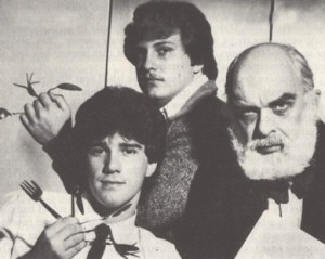
Project Alpha was a hoax designed by James Randi, Steve Shaw (a.k.a. Banachek), and Mike Edwards from 1979-1983. Randi trained two young mentalists/magicians—Banachek was 18 and Edwards 17 when the project began—to fake psychic powers while being investigated in a serious scientific setting. They were able to fool the scientists for four years through more than 160 hours of experiments on their paranormal powers.
 In 1979, James S. McDonnell, board
chairman of McDonnell-Douglas Aircraft and devotee of the paranormal, gave
$500,000 to Washington University in St. Louis, Missouri, for the
establishment of the McDonnell Laboratory for Psychical Research. Randi saw
this as an opportunity to disprove the complaint of many parapsychologists
that they were unable to do properly controlled experiments because of lack
of funding.
In 1979, James S. McDonnell, board
chairman of McDonnell-Douglas Aircraft and devotee of the paranormal, gave
$500,000 to Washington University in St. Louis, Missouri, for the
establishment of the McDonnell Laboratory for Psychical Research. Randi saw
this as an opportunity to disprove the complaint of many parapsychologists
that they were unable to do properly controlled experiments because of lack
of funding.
Randi believed that funding was the least of their problems. In his view, the main obstacle to parapsychology was its “strong pro-psychic bias.” This bias blinds researchers to numerous flaws in their protocols, almost all of which are related to their naïveté regarding human deception and their inexperience at detecting such deception. Some parapsychologists, such as Stanley Krippner, then president of the Parapsychological Association, agreed with Randi that qualified, experienced conjurors were essential for design, implementation, and evaluation of experiments in parapsychology, especially where deception--involuntary or deliberate--by subjects or experimenters, might be possible. But many parapsychologists ignored Randi, as they had been ignoring similar criticism for more than a century and a half.
Randi trained Banachek and Edwards so well that out of 300 applicants they alone were selected as subjects. The director of the McDonnell Lab was physics professor Peter R. Phillips, who had been dabbling in parapsychology for about ten years. He told the press that his lab would investigate “psychokinetic metal bending (PKMB) by children.” Randi sent Phillips a list of protocols (he called them “caveats”) that should be instituted when testing human subjects to prevent deception. One of the things he warned him about was not to allow the subjects to run the experiments by changing the protocol, a practice Randi knew is a common ploy of alleged psychics. He also warned that capricious demands by subjects might well be the means of introducing conditions that would permit subterfuge. Randi also advised that a conjuror be present during the experiments and even volunteered himself at his own expense to do the observing. Phillips told Randi he was quite confident he could conduct proper experiments without Randi’s help. Randi writes
Though I had specifically warned Phillips against allowing more than one test object (spoon or key, for example) to be placed before a subject during tests, the lab table was habitually littered with objects. The specimens were not permanently marked, but instead bore paper tags attached with string loops. Banachek and Edwards found it easy to switch tags after the objects had been accurately measured, thus producing the illusion that an object handled in the most casual fashion had undergone a deformation (Randi: 1983a).
Phillips and his lab assistants became convinced the boys
had psychic powers but they also thought of their work as exploratory. In
1981, they took a videotape of the Banacheck/Edwards sessions to a
convention of the Parapsychological Association. Their colleagues at the
convention are said to have laughed at the video and noted numerous weak
spots in their protocols.
Soon afterward the McDonnell folks began instituting protocols that had been
suggested by Randi. Almost simultaneously they found that the boys seemed to
have lost their ability to produce psychic effects. It was at this point
that the boys were dismissed and Randi made the hoax public. Randi’s take on
the project after it was completed was
If Project Alpha resulted in Parapsychologists (real parapsychologists!) awakening to the fact that they are able to be deceived, either by subjects or themselves, as a result of their convictions and their lack of expertise in the arts of deception, then it has served its purpose. Those who fell into the trap invited that fate; those who pulled back from the brink deserve our applause (Randi: 1983b).
Twenty years later he comments: “The effect of Alpha didn’t last long” (personal correspondence). By that I think he meant that this exposé, like many others before it, has had little impact on the parapsychological community. Rather than thank skeptics for vividly demonstrating how easy it is for very intelligent, highly trained professionals to be fooled by conjurers, they ignore the skeptics. Or worse, they accuse them of “offensive incredulity.”
Some might think that Project Alpha was unethical. I don't. The experiment may have deceived and embarrassed some people, but that was not its purpose. It was a social experiment that was necessary to demonstrate a charge that skeptics had been making for over 150 years. Parapsychologists, no matter how intelligent or well-trained they are in science, are susceptible to deception and self-deception. This has been evident at least since 1882 in the first experiment by the Society for Psychical Research.
In 1882, Sir William Fletcher Barrett, a professor of physics at the Royal College of Science in Dublin, and a few friends, including the Cambridge philosopher Henry Sidgwick, formed the Society for Psychical Research (SPR). The goal of the society, in part, according to Sidgwick was to
drive the objector into the position of being forced either to admit the phenomena as inexplicable, at least by him, or to accuse the investigators either of lying or cheating or of a blindness or forgetfulness incompatible with any intellectual condition except absolute idiocy.
SPR's first scientific study would have Sidgwick eating those words.
Barrett led SPR's first study. It involved a clergyman’s four teenage daughters and a servant girl who claimed they could communicate telepathically. He did a number of experiments with the girls and came away declaring that the odds of their being able to guess correctly in one experiment “were over a million to one.” The odds of their guessing correctly five cards in row were “over 142 million to one” and guessing correctly eight consecutive names in a row were “incalculably greater” (Christopher 1970: 10). More men of integrity with high degrees were brought in to witness the telepathic powers of the Creery girls and Jane Dean, the servant girl. All the scientists agreed that there was no trickery involved. How did they know? They had looked very carefully for signs of it and couldn’t find any!
A skeptic might ask: What are the odds that children can fool some very intelligent scientists, even if the children come from a clergyman’s home? The answer is: the odds are very good. Almost immediately the scientists were criticized for being taken in by tricks any magician could perform. It took some time to sink in but eventually the experimenters realized that for some reason human beings like to deceive each other. They use all kinds of non-verbal signals to communicate, which can give the appearance of telepathy. They use glances (up, down, right, left for the four suits of a deck of cards, for example), coughs, sighs, yawns, and noises with their shoes. Other cheaters use Morse code with coins and various other tricks known to conjurers. Sometimes gestures to various parts of the body have a prearranged meaning.
Barrett and his colleagues were not oblivious to the problems of cheating or non-telepathic explanations for what they were observing. The experiments are described by Susan Blackmore:
Typically someone thought of a name, or a playing card, or a familiar household object, and the girls could apparently guess, almost always correctly, what had been chosen. The authors discussed muscle reading and involuntary guidance and concluded that these could not be responsible for the impressive results. It is interesting that right at the start they point out that the word 'thought-reading' was used only as a 'popular and provisional description, and is in no way intended to exclude an explanation resting on a physical basis' (Barrett el al. 1882, p. 33).
So the enterprise began well, with a determination to rule out obvious errors, an open-minded attempt to test whether the phenomena really did exist and an eye to possible theories for the future. But I should add ... that it was fed by a hope that the phenomena would prove to be real and would, in their words, 'necessitate a modification of that general view of the relation of mind to matter to which modern science has long been gravitating' (Barrett et al. 1882, p. 34).
It took six years for these rather intelligent men to discover the girls’ trickery. While one group of scientists was validating the Creery group, another from SRP was validating the amazing telepathic feats of a 19-year-old entertainer named George A. Smith and his partner in deception, Douglas Blackburn. Smith became secretary of the SPR (Christopher 1970) and had Blackburn not eventually published a series of articles explaining how they fooled the scientists, the world might never have known the details of the trickery (Gardner 1992). The early scientific studies demonstrate the naïveté of the experimenters and the need for experts in non-verbal communication and deception, namely, conjurors or gamblers, to help them set up protocols to prevent cheating.
Unfortunately, the lesson of the Creery girls and the Smith-Blackburn hoax went largely unheeded by most paranormal investigators in the ensuing 150 years, making Project Alpha necessary.
See also Carlos hoax, Soal-Goldney experiment, Steve Terbot hoax, Frauds and Hoaxes- topical index, and A Short History of Psi Research by Robert Todd Carroll.
further reading
books and articles
Barrett, W. F., E. Gurney, and F. W. H. Myers. 1882. Proceeding of the Society for Psychical Research. 1, 13-34.
Christopher, Milbourne (1970). ESP, Seers & Psychics. Thomas Y. Crowell Co.
Gardner, Martin. 1992. On the Wild Side. Prometheus Books.
Randi, James (1983b). “The Project Alpha Experiment: Part two: Beyond the Laboratory,” Skeptical Inquirer. Fall.
Randi, James (1982). Flim-Flam! Psychics, ESP, Unicorns, and Other Delusions. Prometheus Books.
websites
Jim Lippard's comments on Alpha
Project Alpha
and the Spoon Benders by Alan Bellows


 Procera AVH